
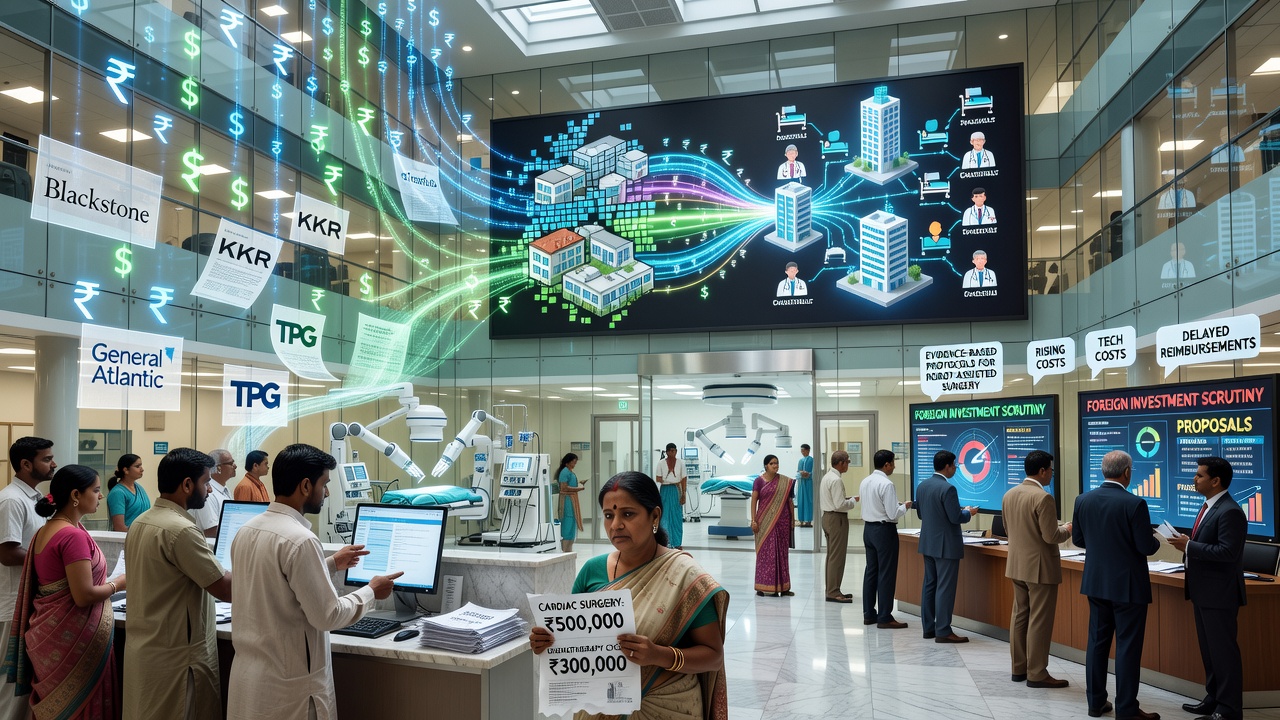
About $10 billion has moved from global private equity firms into Indian hospital chains over the past five years, according to data compiled by EY. Blackstone, KKR, TPG, General Atlantic and others have bet on a country with one of the world's widest gaps between hospital beds and population. That bet is now colliding with a harder question: whether the capital pouring into operating theaters is quietly reshaping what patients pay at the checkout counter.
A Shortage Turned Into an Opportunity
India's case for investment was straightforward on paper. The country has roughly 1.3 hospital beds per 1,000 people, well below levels common in developed economies, while demand for cardiac treatment, cancer care and other specialized services has climbed alongside rising incomes and longer life expectancy. Policymakers themselves flagged around 600 hospital projects requiring an estimated $32 billion of investment in 2021 - a figure that captured both the scale of the shortfall and the size of the opportunity private capital saw in filling it.
Fragmentation made the sector especially attractive to consolidators. Standalone hospitals, often family-run and undercapitalized, could be combined into larger networks with broader specialist offerings, better bargaining power with suppliers and higher returns on capital. Private-equity-backed operators still account for less than 5% of India's hospital beds, but their footprint is concentrated in high-margin specialties such as cardiac surgery and oncology - precisely the areas where pricing and technology intersect most visibly.
Returns Have Been Real - and Visible
The financial results have validated the thesis for some investors. KKR's backing of Radiant Life Care, later merged into listed Max Healthcare Institute Ltd., is widely cited in the industry as a successful exit. Temasek Holdings reportedly generated roughly a tenfold return on its 2017 investment in Manipal Health Enterprises following a partial stake sale during the company's 2024 initial public offering, with an internal rate of return of about 30%, according to VCCircle. KKR has since moved to expand further, agreeing in August to acquire the Indian operations of Sweden's Medicover AB for $1.4 billion - a deal that would nearly double its hospital-bed count in southern India.
India's deepening capital markets have reinforced this cycle. Public listings and secondary share sales give private equity firms a clear route to cash out, which in turn frees capital for the next round of acquisitions. Ratings agency Crisil expects private hospital revenue to grow as much as 15% in fiscal 2027, driven by higher patient volumes and rising average revenue per occupied bed.
Where the Friction Lives
Growth on this scale has not gone unnoticed by regulators or insurers. A parliamentary committee in August warned that an unchecked influx of foreign capital was enabling large corporate groups to acquire cost-effective, midsize hospitals, and recommended revisiting foreign investment rules, examining price caps and creating a dedicated hospital regulator. The committee also found that private hospital treatment can cost five to ten times more than care in the public system, with some of the widest gaps in cancer, cardiac, kidney and maternity treatment.
Insurers argue that private hospitals, including PE-backed chains, are steering patients toward costlier procedures and inflating bills. Hospital operators counter that delayed insurer payments and thin reimbursement rates are squeezing their margins. The dispute increasingly centers on newer, expensive interventions: insurers want evidence-based treatment protocols before covering procedures such as robot-assisted surgery, while hospitals argue that newer techniques improve outcomes even if they raise costs. Patients are often caught between the two positions after treatment decisions have already been made.
A Familiar Regulatory Dilemma
India is not the first market to confront this tension. The United States has debated whether regulation can meaningfully contain healthcare costs for decades, without a clear resolution - a point academics who study both systems have raised in comparing the two markets. Investors, meanwhile, warn that price controls or tighter foreign investment rules could discourage the capital India still needs to expand hospital capacity.
- Regulators are weighing foreign investment limits, price caps and a dedicated hospital oversight body.
- Insurers are pushing for standardized, evidence-based treatment protocols before approving high-cost procedures.
- Hospital operators cite rising technology and operating costs, alongside delayed insurer reimbursements.
- Patients without employer or government-backed coverage face the most direct exposure to rising bills.
The outcome will shape more than hospital balance sheets. It will determine whether India can keep attracting the capital needed to close its bed shortage without pushing routine care beyond the reach of the households least able to absorb rising costs.