
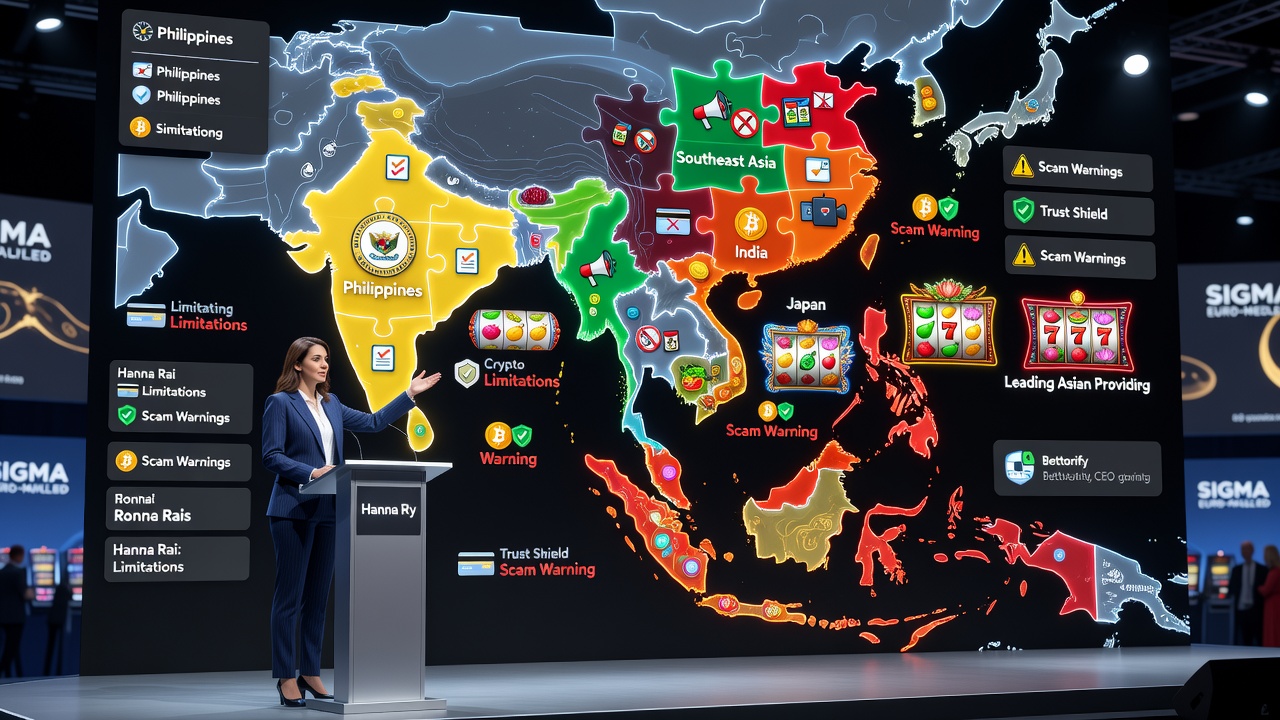
Asia's iGaming sector is heading toward $66.79 billion in revenue this year, according to Statista, with a modest 2.0% compound annual growth rate expected to push the market to roughly $72.42 billion by 2029. Online gambling specifically is projected to grow from $12.97 billion in 2025 to about $14.73 billion by 2028. Behind those steady figures sits a much messier reality: a region split into dozens of regulatory regimes, payment cultures, and player expectations that punish operators who treat Asia as a single market.
A patchwork, not a platform
Unlike Europe, where regulatory frameworks and payment infrastructure have converged enough to allow shared templates across borders, Asia offers no such shortcut. Each jurisdiction sets its own rules on licensing, advertising, and payments, and consumer preferences shift sharply from one country to the next. Hanna Rai, CEO of Bettorify, speaking with SiGMA News at SiGMA Euro-Med in Malta, argued that operators importing Western-designed platforms into Asian markets tend to misjudge everything from colour psychology to game selection. Dark, minimalist interfaces that perform well in Europe often underperform in Southeast Asia, where lighter themes and different visual cues resonate more with players. Leading game providers in the region also differ from those dominant in Western markets, meaning a platform built around European supplier relationships may simply be offering the wrong content.
Regulatory volatility as a business variable
Recent action in the Philippines against Philippine Offshore Gaming Operators illustrates how quickly the ground can shift. Rai described regulatory change as a constant now, not an occasional disruption, and said operators need to budget time, staff, and capital specifically for compliance monitoring rather than treating it as a one-time cost of market entry. That shift in posture - from reactive to anticipatory compliance - reflects a broader trend across gambling regulation globally, where enforcement is becoming faster and less predictable. For operators and platform providers, this means geopolitical and legal risk has become a permanent line item rather than a passing concern.
Payments, trust, and the crypto question
Card payments, the default rail in much of Europe, carry far less weight in Asia. Rai pointed out that this actually removes some friction points common in Western markets, but it does not eliminate the trust deficit that surrounds financial transactions in the region, including concerns about scams in both everyday banking and gambling specifically. Regulated cryptocurrency is emerging as a direction operators are watching closely, offering players more control over their funds, though adoption across Southeast Asia remains uneven. Any expansion of crypto payment rails in gambling will need to be paired with clear consumer protections, given the sector's exposure to fraud and the difficulty regulators face in tracking decentralised transactions.
Player protection as infrastructure, not afterthought
Rai was direct about the tension built into gamification and retention design: tools created to keep players engaged carry a responsibility to also protect them. She described responsible gambling measures as preventive infrastructure that operators, platforms, and payment providers all need to build in from the start, rather than bolt on later. That framing matters for a region where regulatory maturity varies widely and where some markets still lack the consumer-protection frameworks common in more established gambling jurisdictions. As AI-driven personalisation becomes more common in shaping player experience, the same data and behavioural insight used to increase engagement will need matching investment in harm-reduction tools.
What entry into Asia actually requires
- Local partnerships with professionals already embedded in target markets, rather than attempts to replicate a single global model.
- Ongoing compliance monitoring built into operating budgets, given how quickly rules can change across jurisdictions such as the Philippines.
- Payment strategies adapted to regional habits, with attention to trust-building rather than assuming card-based systems will transfer.
- Responsible gambling safeguards designed alongside retention tools, not added afterward.
The underlying message from Rai's conversation with SiGMA News is that Asia's growth numbers, while real, do not translate automatically into revenue for operators who arrive with untested assumptions. Market entry now depends less on capital and more on whether operators are willing to treat each jurisdiction as its own distinct business problem.