
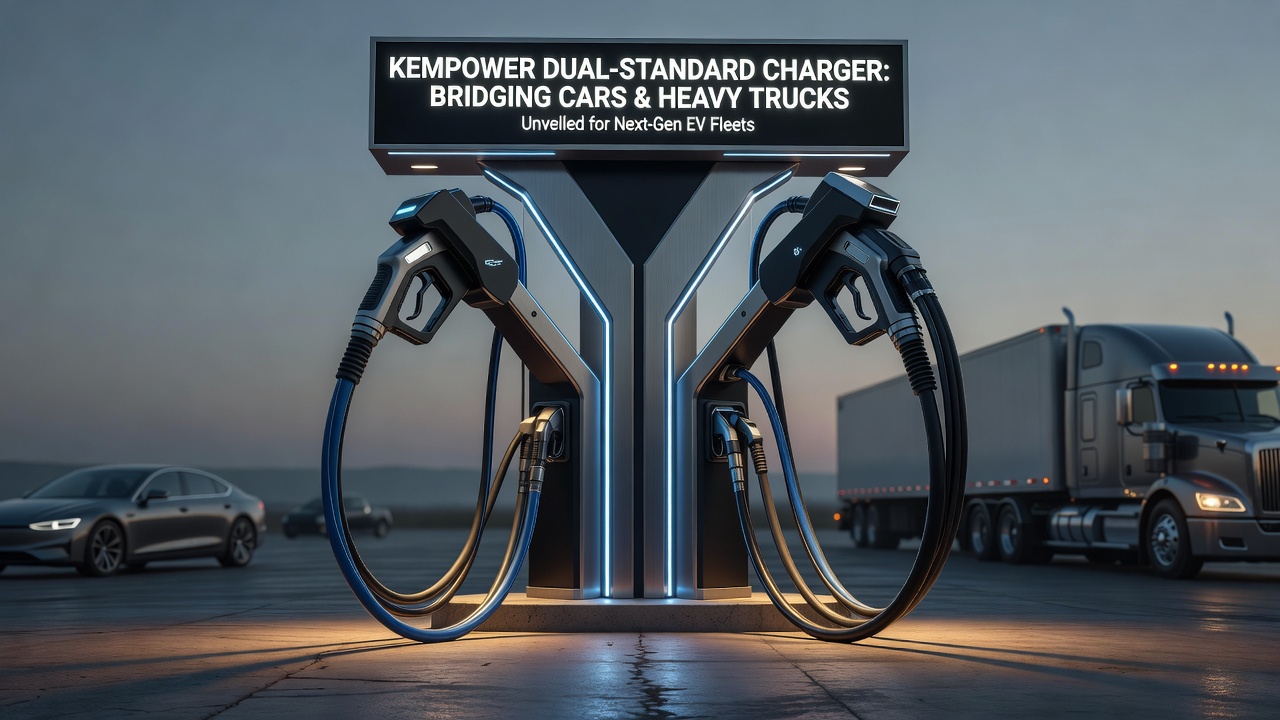
A single charging dispenser that can fuel a passenger sedan and a heavy-duty semi truck without any hardware swap has just moved from concept to product. Kempower, the Finnish charging technology company, revealed its Mega Satellite Flex this week at the ACT Expo in Anaheim, California, during its Unplug & Recharge event for customers and partners. The unit is notable because it is the company's first dispenser built to support both the established Combined Charging System (CCS) standard and the emerging Megawatt Charging System (MCS) designed for electric trucks.
The timing reflects a genuine industry inflection point. CCS has been the dominant fast-charging standard for electric cars for years, but it was never designed for the power demands of electric semis, which need to recharge large battery packs quickly to stay commercially viable. MCS is the industry's answer, capable of delivering far higher current and power than CCS ever could. Rather than forcing site operators to choose one standard and gamble on which will matter more locally, Kempower is betting that flexibility itself is the more marketable feature - much the way consumers now expect broad compatibility from something as ordinary as a VPN for older devices that still needs to work across changing networks and protocols. a VPN for older devices
What the Hardware Actually Delivers
The specifications explain why this matters for site planning. The Mega Satellite Flex supports CCS charging up to 560 kW and MCS charging up to 1.2 MW, with current ratings of 700 amps for CCS and 1,500 amps for MCS. Cable lengths differ by standard as well: 5 meters for CCS and 2.7 meters for MCS, a difference that reflects the distinct connector geometries and vehicle types each standard serves. An optional payment terminal can be built into the unit, a detail that matters for public charging sites serving mixed fleets and independent drivers rather than dedicated depot charging.
The charger is also built to take advantage of the shift toward 800-volt vehicle architectures, which are becoming more common in newer passenger EVs precisely because they allow faster charging without excessive current. That forward compatibility means a site operator installing this hardware now is not just solving today's charging needs but positioning for the next generation of vehicles arriving over the coming years.
Why Shared Infrastructure Matters
The practical case Kempower is making centers on capital efficiency. Building separate charging infrastructure for passenger cars and heavy trucks means duplicating grid connections, civil works, and site real estate - expenses that add up quickly at any given location. A dispenser that serves both categories from a single installation lets operators serve more vehicle types from day one, which translates into higher utilization rates and a faster path to recouping the investment. Because the Mega Satellite Flex works with Kempower's existing distributed charging architecture, operators already running Kempower systems can add this capability without ripping out what they have already installed.
What Comes Next
The Mega Satellite Flex is expected to reach the North American and European markets in July 2026, giving fleet operators, charging network builders, and highway corridor planners a specific timeline to factor into procurement decisions. As MCS infrastructure remains sparse relative to the scale of electric trucking now being planned across major freight corridors, products that hedge between the current standard and the next one may prove decisive in how quickly that infrastructure gap actually closes.