
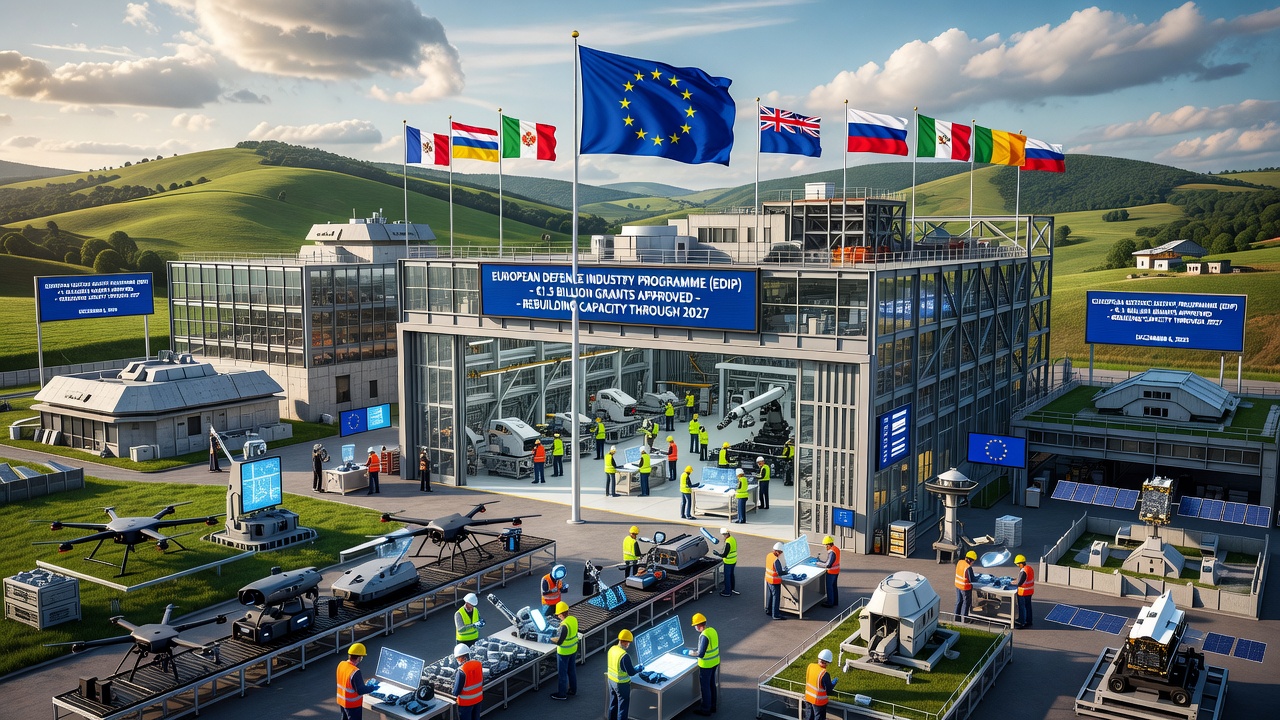
The Council of the European Union adopted the European defence industry programme (EDIP) on 8 December 2025, committing €1.5 billion in grants to strengthen Europe's defence manufacturing base through 2027. The programme responds to a security environment that has pushed EU governments to treat industrial readiness, not just stockpiles, as a strategic priority.
What EDIP Actually Funds
EDIP is not a single pot of money for buying weapons. It is a legal and financial framework designed to make the European defence sector work more like an integrated market and less like a patchwork of national suppliers. The money comes from the EU's long-term budget, the multiannual financial framework for 2021-2027, and member states or outside partners can add further contributions. The programme builds on two earlier instruments, EDIRPA, which supported joint procurement, and ASAP, which targeted ammunition production, extending their logic into a broader industrial policy. Of the total budget, €300 million is reserved for a dedicated Ukraine support instrument, which incentivises cooperative procurement with Ukrainian industry and helps Ukrainian manufacturers scale up production.
Common Projects and a New Sales Mechanism
A central feature of EDIP is the creation of "European defence projects of common interest," intended to build capabilities that matter across the bloc rather than to any single country. On 28 September 2026, the Council approved the first five such projects, covering drones and counter-drone systems, maritime and seabed defence, space, air and missile defence, and protection of Europe's eastern flank. These categories reflect where EU planners see the most acute capability gaps. EDIP also establishes a European military sales mechanism, offering a centralised catalogue of defence products and the option to create shared "pools" of equipment, aimed at cutting delivery times during periods of heightened demand. Alongside this sits the EU's first dedicated security-of-supply regime, intended to keep crisis-relevant components and products flowing even under strain.
Who Qualifies for Funding
Eligibility rules are deliberately restrictive, reflecting a push for strategic autonomy rather than open international competition. Companies must be established in the EU with executive management structures based there, and must use EU-based infrastructure, facilities and assets to qualify for support. At least 65% of the total cost of components in a funded product must originate from the EU or countries associated through the European Economic Area. Design authority over a product, meaning control over its technical specifications, must generally sit within the EU as well. The rules also bar sourcing components from non-associated countries whose interests conflict with EU security policy, a clause that ties industrial funding directly to geopolitical alignment.
Why the Structure Matters
EDIP implements measures first outlined in the European defence industrial strategy presented by the Commission and the EU's foreign policy chief in March 2024. The programme's design signals a shift from reactive emergency funding toward longer-term industrial planning, including a legal toolbox meant to make multi-year armaments cooperation between member states easier to structure. The Council and Parliament have already asked the Commission to look at additional financing options beyond the current €1.5 billion, suggesting this is viewed as a starting framework rather than a final figure. For an industry historically fragmented along national lines, the test will be whether shared procurement and common projects actually reduce duplication, or simply add another layer of coordination on top of existing national programmes.