
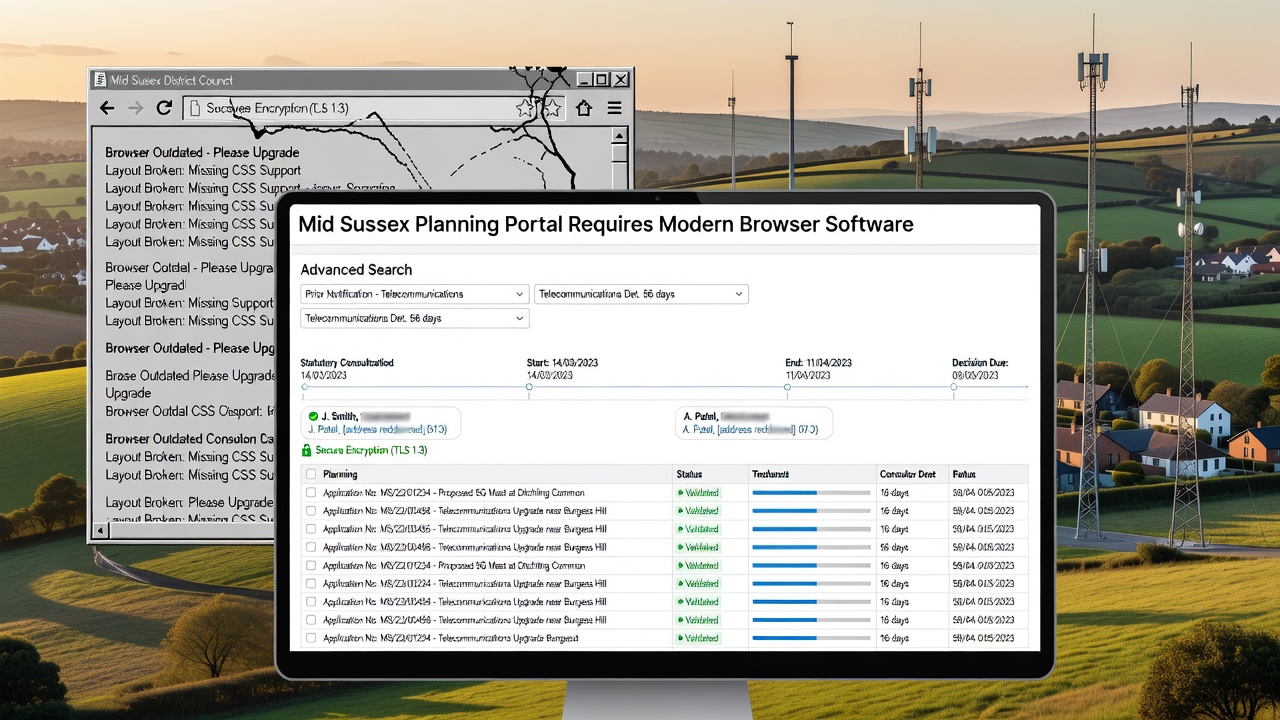
Councils across England are steadily retiring compatibility with outdated web browsers, and Mid Sussex District Council's Online Planning Register is the latest local government digital service to draw a firm line. Residents and businesses trying to search planning applications, including records of telecommunications and phone mast installations, are now told plainly: the register will not function correctly on older browsers, and anyone encountering problems should update their software before contacting support.
Why Local Authority Platforms Are Phasing Out Legacy Browsers
This is not a cosmetic inconvenience. Public sector platforms, like many commercial digital services, increasingly rely on modern web standards for security, encryption, and interactive features such as advanced search filters. Older browsers often lack support for these protocols, which means they cannot safely or reliably render dynamic content like searchable planning databases. Maintaining backward compatibility with obsolete software also diverts limited council IT resources away from improving core services and strengthening data protection, which is a growing priority given that users must submit personal details, including name and address, when registering comments on applications.
The planning register is not a trivial tool. It allows the public to track applications, review telecommunications mast proposals, and submit formal comments during statutory consultation periods. A platform that fails intermittently on outdated software risks excluding residents from a process that has real planning and community implications, from mobile network coverage to development decisions affecting neighbourhoods.
What Users Need to Know Before Searching
The council has structured the register around a fairly technical search process, which makes browser reliability even more important. Users are directed to the Advanced Search function, where selecting the correct application type, such as "Prior Notification - Telecommunications" or "Telecommunications Det. 56 days," determines whether results appear at all. A malfunctioning browser can distort these filters or prevent search results from loading, leaving users unable to find relevant applications even when the underlying data exists.
- Telecommunications and phone mast applications can be searched by application type or by operator name entered as a description keyword.
- Applications outside the statutory consultation window require direct contact with the case officer rather than an online comment.
- Comments submitted in writing or by email may take up to five working days to appear on the register, since names and addresses must be verified first.
- Larger or contested applications may be referred to a planning committee, with written notice sent to those who have already commented.
A Wider Pattern in Public Digital Services
Mid Sussex is far from alone. Government and council websites nationally have been nudging users toward updated browsers for several years, partly driven by cybersecurity obligations and partly by the practical cost of supporting legacy code. For residents, the message is simple and recurring across public services: keeping browser software current is no longer optional if they want uninterrupted access to registers, applications, and consultation processes that increasingly exist only online. Those who still encounter issues after updating are advised to contact the planning department directly, either by phone, email, or post, to ensure their query or comment is not lost to a technical fault.