
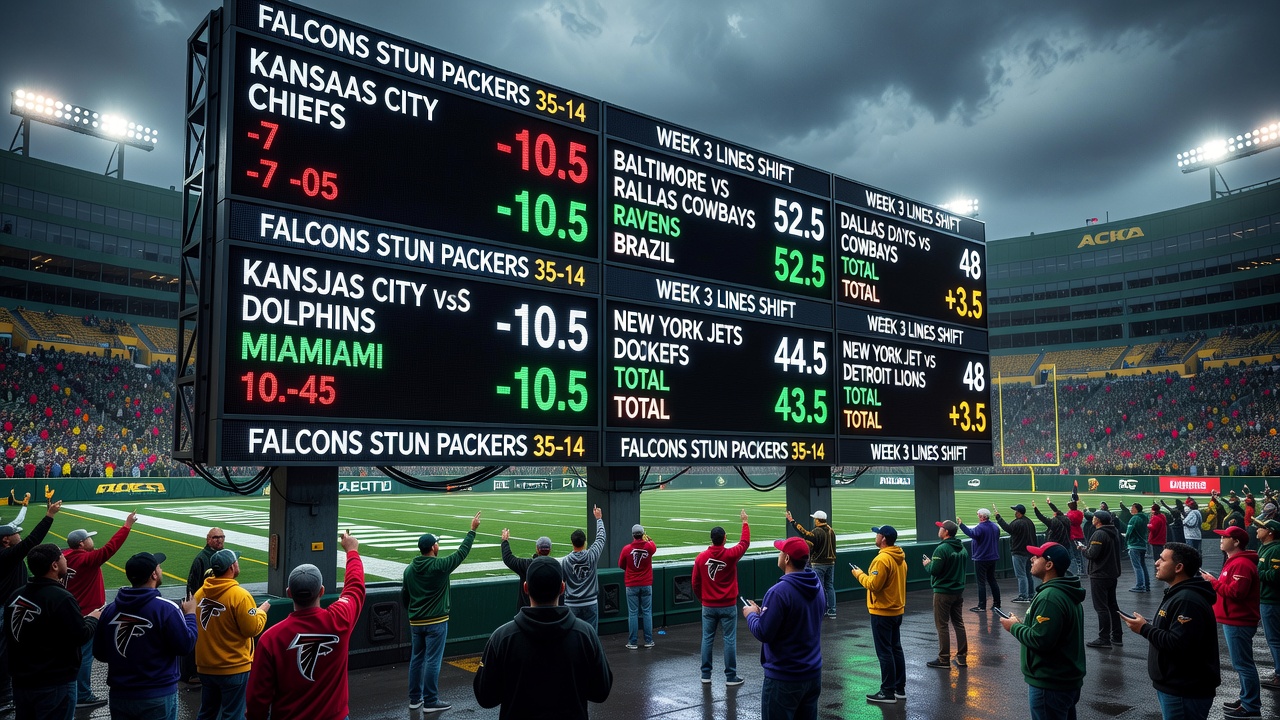
A Thursday night upset reshaped the opening odds board for NFL Week 3. The Atlanta Falcons, listed as touchdown underdogs, dismantled the Green Bay Packers 35-14 at Lambeau Field, a result that reset expectations before the rest of the week's slate even kicked off. The Kansas City Chiefs now stand as the week's largest favorite, laying 10.5 points on the road against the Miami Dolphins, while the Baltimore Ravens-Dallas Cowboys game in Brazil carries the highest total of the week at 52.5.
How Oddsmakers Read a Blowout
The Falcons-Packers result is a reminder that point spreads are forecasts, not guarantees - probability estimates built from team performance data, injury reports, and market behavior, not predictions of certainty. A double-digit underdog winning by three scores doesn't break the model; it reflects the inherent variance that makes football wagering risky by design. Books adjust lines throughout the week based on new information and bettor action, which is why several Week 3 matchups show meaningful movement from their opening numbers. The Dolphins-Chiefs line opened at Chiefs -7 and has since climbed to -10.5, while the Jets-Lions total jumped from 44.5 to 48.5 as more money and information flowed in.
Favorites, Underdogs, and the Gap Between Vegas and Analytics
This week's board shows a split between market-set lines and predictive models like ESPN's FPI. In most matchups, the two line up closely - the Chiefs are favored by both the sportsbook line and FPI, which gives Kansas City an 84% probability to win outright. But smaller gaps appear elsewhere: the Jaguars are favored by 3 points on the market but by just 2.1 points per FPI, with a win probability of only 57%. These discrepancies illustrate why spreads aren't simple win projections - they incorporate expected scoring margin, not just likelihood of victory, and bettors treat the two signals differently depending on their own analysis.
What the Totals and Movement Signal for Consumers
Total movement is often as revealing as spread movement. The Chargers-Bills total rose two points from its open, while the Seahawks-Commanders total dropped six points, from 46.5 to 40.5 - a sign that oddsmakers and bettors increasingly expect a lower-scoring, more defensive matchup than initially projected. For everyday consumers of this information, it's worth remembering that line movement reflects market consensus and risk management by sportsbooks, not inside knowledge of outcomes. Odds are priced to balance action and protect the house margin built into every line, regardless of which side the public favors.
A Note on Responsible Engagement
Week-to-week swings like the Falcons' upset underscore a basic truth about sports wagering: no favorite is safe, and no underdog is hopeless. That unpredictability is part of the appeal for fans, but it also means spreads, totals, and moneylines should be read as structured estimates of uncertainty rather than reliable forecasts. Anyone following these numbers should treat them as entertainment-adjacent information, understand that all betting carries financial risk, and recognize that regulated sportsbooks are required to provide resources for those who want to monitor or limit their own wagering activity.