
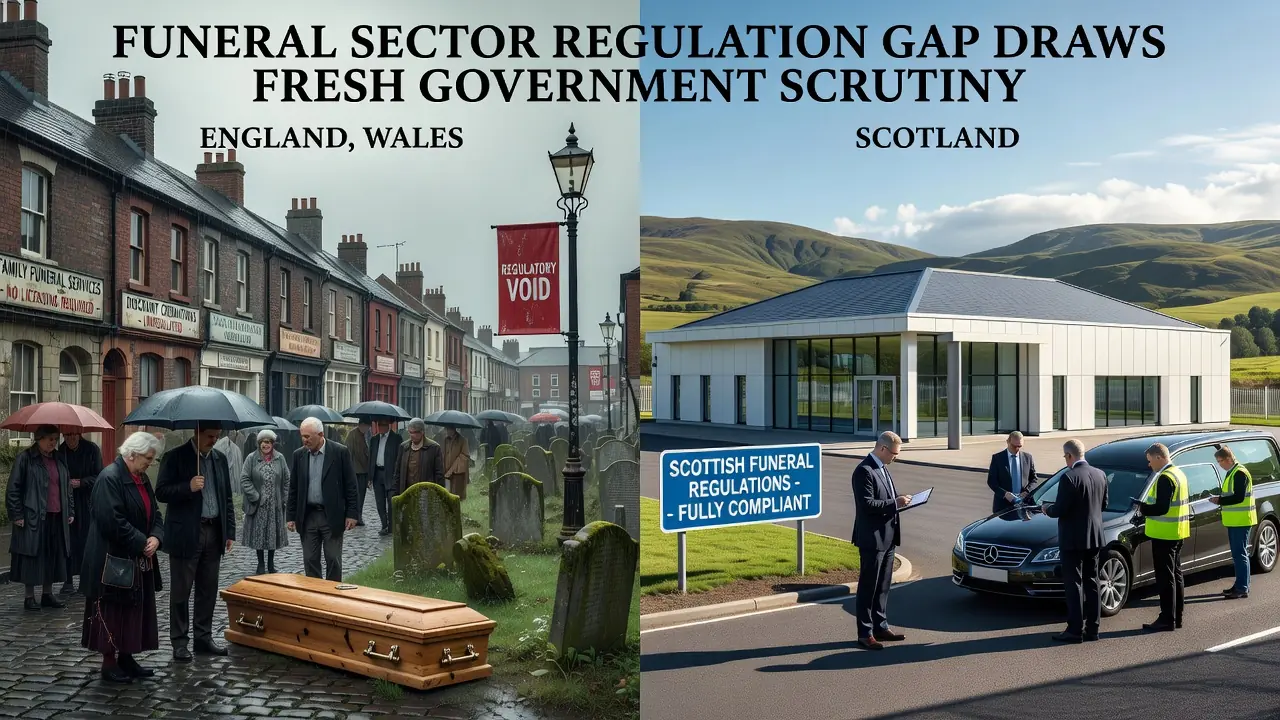
Anyone arranging a funeral in England, Wales or Northern Ireland is dealing with an industry that has no dedicated regulator. There is no licensing body checking qualifications, no statutory inspector verifying how the deceased are stored or transported, and no legal requirement to belong to a professional association. The only part of the sector under formal oversight is pre-paid funeral plans, which fall within the remit of the Financial Conduct Authority because they involve consumers handing over money years in advance of a service being delivered.
Voluntary Codes, No Legal Teeth
Two trade bodies, the National Association of Funeral Directors and the National Society of Allied and Independent Funeral Directors, publish codes of practice and set quality benchmarks for their members. Membership, however, is optional, and a funeral director can operate perfectly legally while ignoring both organisations entirely. Health and safety law, competition law and consumer protection law still apply, as they would to any business, but none of these frameworks was designed with the specific vulnerabilities of bereaved customers or the handling of human remains in mind.
Warnings That Went Largely Unanswered
The Competition and Markets Authority flagged this gap in 2020, recommending an inspection and registration body to monitor how funeral directors care for and transport the deceased, alongside measures to make pricing clearer for grieving families who are often poorly placed to shop around. The then Conservative government judged that full regulation might be disproportionate, favouring a co-regulatory model built on collaboration with industry instead.
Events in Hull tested that judgment. An investigation by Humberside Police into Legacy Independent Funeral Directors led to funeral director Robert Bush facing 64 charges, including 30 counts of preventing a lawful and decent burial. The case prompted renewed calls for statutory oversight and pushed the outgoing government to plan a call for evidence before the 2024 general election intervened.
An Inquiry Calls the Sector "Unregulated"
Separately, the independent inquiry examining the David Fuller case - in both its 2024 interim report and 2025 final phase 2 report - urged the government to establish an independent statutory regulatory scheme for funeral directors in England "as a matter of urgency". Its conclusion was blunt: the sector amounted to "an unregulated free for all". The incoming Labour government responded cautiously, saying in late 2024 and early 2025 that it was weighing "some form" of regulation, provided any new rules were proportionate. By autumn 2025 the work had become cross-departmental, and in March 2026 the Ministry of Justice confirmed it was actively exploring whether criminal law covering the treatment of the deceased needed strengthening, including potential new offences. Following Bush's sentencing on 31 July 2026, the government announced plans to crack down on rogue operators in the sector - a direct response to what it called a harrowing case.
Scotland's Different Path
North of the border, the contrast is stark. Concerns about infant cremation practices led to the 2014 Infant Cremation Commission report and a further 2016 investigation, both recommending regulatory intervention. The Scottish Parliament responded with the Burial and Cremation (Scotland) Act 2016, establishing inspection powers, a code of practice and a licensing framework for funeral directors.
- Inspection regulations for funeral businesses and burial/cremation authorities took effect on 1 March 2025, following consultations in 2017 and 2023 that found near-unanimous support for inspections.
- A statutory code of practice, approved by the Scottish Parliament in January 2024, also came into force on 1 March 2025.
- A searchable Funeral Sector Register went live on 1 April 2025, giving the public a record of active operators.
- A licensing scheme for funeral directors remains under development.
The divergence matters for consumers and the industry alike. Families in Scotland now have statutory recourse and a public register to check before engaging a provider; those in England, Wales and Northern Ireland still rely on voluntary codes and general consumer law. For an industry handling one of the most sensitive transactions a person will ever make, that gap has become increasingly difficult for policymakers to defend.