
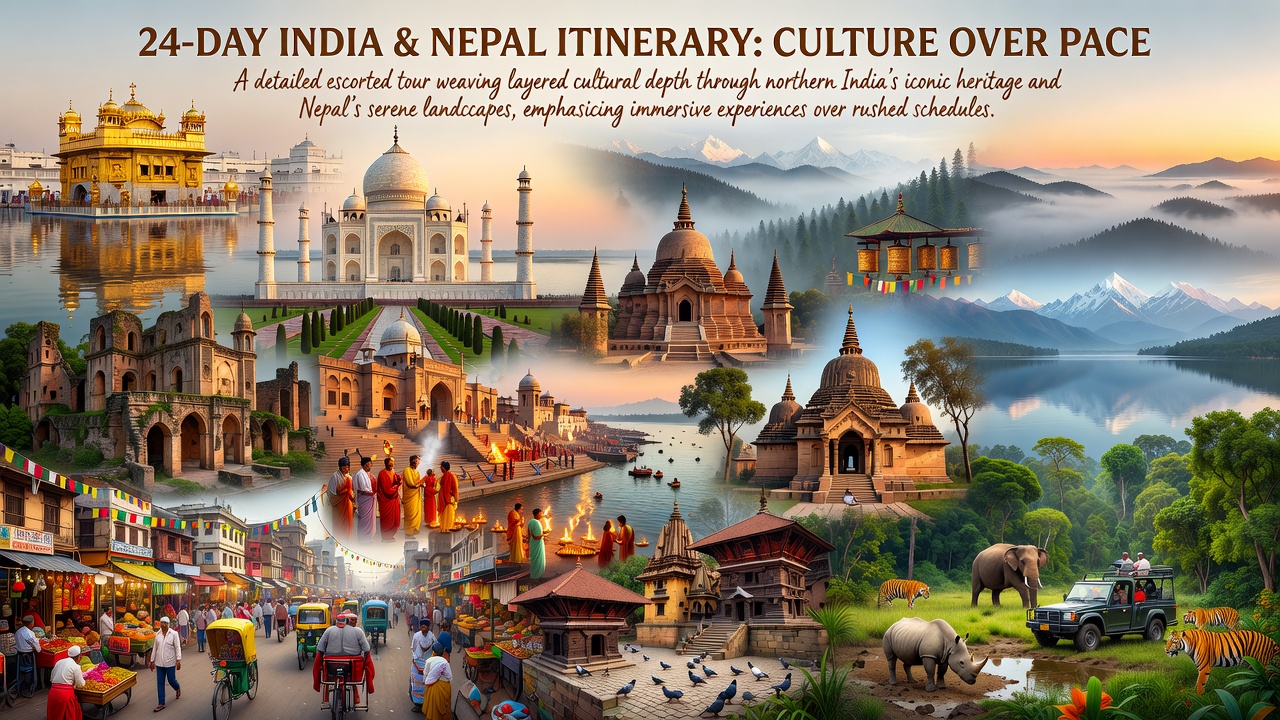
A newly packaged 24-day escorted tour through northern India and Nepal joins a crowded field of long-haul cultural itineraries, but its structure says something about where the escorted touring market is heading. Rather than condensing two countries into a whistle-stop sprint, the route builds in overnight stays, rest days and layered experiences - from the Golden Temple in Amritsar to wildlife safaris in Chitwan National Park - signalling a shift toward depth over volume in multi-country packaged travel.
What the Itinerary Reveals About Changing Traveller Expectations
The tour spans Amritsar, Dharamshala, Delhi, Agra, Lucknow, Varanasi, Kathmandu, Bhaktapur, Gorkha, Pokhara and Chitwan, moving by a mix of coach, domestic train and regional flight. This multimodal structure is increasingly standard in premium escorted travel: operators are leaning on India's rail network, including the Gatimaan and Shatabdi Express services, both to manage journey times and to give the transport itself a cultural dimension rather than treating it as dead time between sights. Free days in Varanasi, Pokhara and Chitwan also reflect a broader industry recognition that packed daily schedules can fatigue travellers on extended trips, particularly those managing jet lag, altitude changes and intense heat across a single itinerary.
Pricing Structure and What "Inclusive" Actually Covers
The package bundles return flights from the UK, a domestic flight within India, a regional flight between India and Nepal, accommodation, airport-to-hotel transfers, coach travel and a stated £580 per person allowance for meals, alongside tour manager services throughout. This all-inclusive framing is common in the escorted touring sector because it allows operators to present a single headline price while absorbing currency fluctuation, fuel surcharges and third-party transport costs internally. For consumers, the key questions remain consistent across this type of product: what counts as a "meal" versus a drink or snack, which excursions are included against which are optional add-ons, and what the cancellation or price-protection terms actually guarantee. The tour's reference to a "Price Promise" and ATOL protection are standard consumer safeguards in UK outbound travel, and ATOL protection specifically matters because it covers the financial risk of airline or tour operator insolvency - a real-world consideration given how dependent this itinerary is on connecting domestic and regional flights.
Cultural Access Versus Cultural Spectacle
Several elements of the itinerary - the Partition Museum in Amritsar, the Residency in Lucknow, Sarnath near Varanasi - sit closer to historical education than tourist spectacle. Pairing these with more visually driven stops, such as the Taj Mahal at sunset or the Ganga Aarti ceremony, suggests an attempt to balance reflective content with the kind of imagery that sells long-haul tours. Operators in this space increasingly position local experiences, such as the Gorkha cooking session or the Tharu village visit in Chitwan, as differentiators against generic sightseeing packages, though travellers should treat "authentic" cultural encounters with a reasonable degree of scrutiny, since the depth of genuine community interaction varies considerably between operators.
Practical Considerations for an Itinerary of This Length
- Altitude and climate shifts: the route moves from Punjab's plains to the Himalayan foothills of Dharamshala and Nagarkot, then down into Chitwan's subtropical terrain, requiring travellers to pack and prepare for varied conditions.
- Wildlife safari activities in Chitwan, including jeep and canoe excursions, carry standard outdoor-activity risk and depend on genuine wildlife sightings not being guaranteed, as is the case with any nature-based tourism product.
- Optional activities, such as paragliding in Pokhara or early-morning mountain flights, typically sit outside the core package price and warrant separate insurance checks.
- A 24-day trip of this nature demands comprehensive travel insurance covering medical evacuation, given the remote stretches between Gorkha, Pokhara and Chitwan.
Long escorted tours of this scale remain a niche but resilient segment of outbound travel, appealing to those who prefer fixed logistics and guided context over independent planning. The trade-off is reduced flexibility: travellers commit to a fixed group pace, a fixed set of inclusions, and a reliance on the operator's choice of accommodation and timing. For a itinerary covering two countries, eleven named destinations and multiple modes of transport, that trade-off is the central decision point for anyone weighing this kind of trip against a self-organised alternative.