
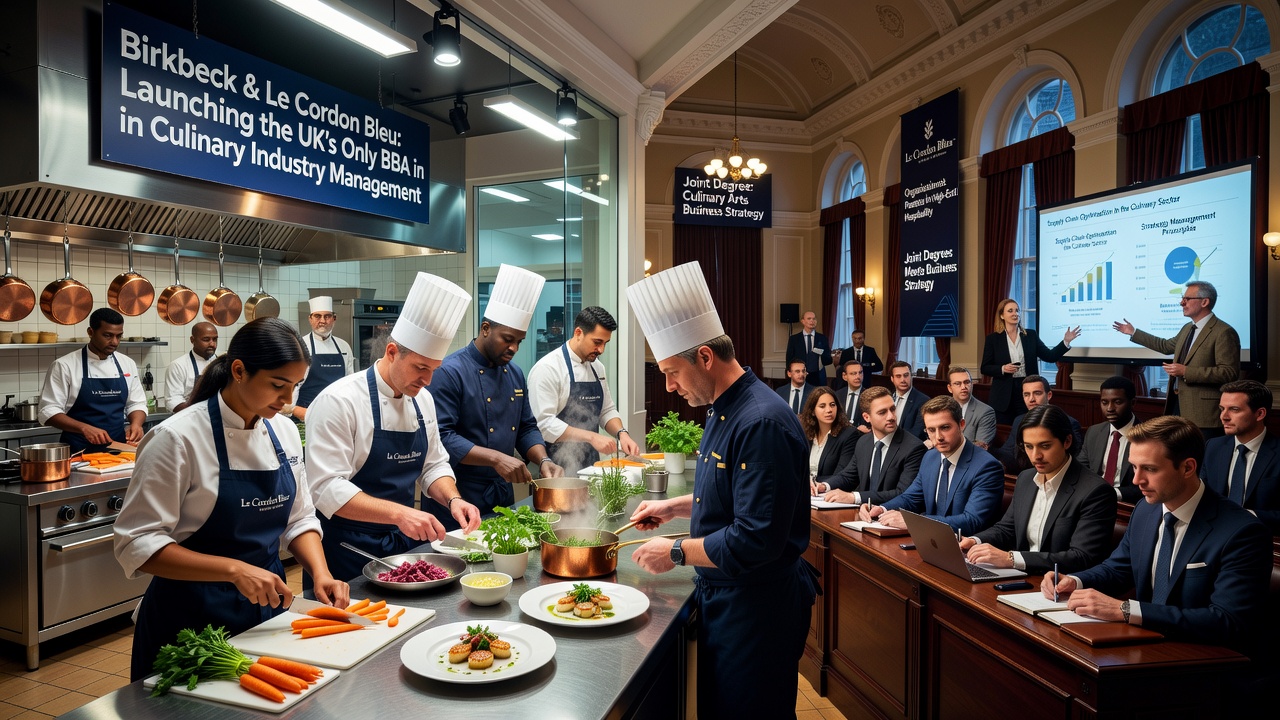
A new undergraduate pathway is addressing a long-standing gap in British higher education: a degree that treats cooking and business management as equally serious disciplines. The BBA in Culinary Industry Management, delivered jointly by Birkbeck, University of London, and Le Cordon Bleu Culinary Arts Institute, is described as the only programme of its kind in the UK. It sits at the intersection of two fields that rarely share a classroom - professional culinary training and formal business education.
Why a hybrid qualification matters for the food industry
Food businesses, from independent restaurants to large hospitality groups, increasingly need staff who understand more than technique. Chefs who move into senior roles are expected to manage budgets, supply chains, staff rotas and brand strategy, often with little formal preparation for that shift. This degree responds directly to that reality by combining Le Cordon Bleu's culinary training, delivered by classically trained chefs in dedicated kitchen facilities, with Birkbeck Business School's teaching in management, strategy and organisational practice. Students are taught by academic staff and industry professionals with direct experience across both sectors, rather than by one institution attempting to cover both disciplines alone.
How the course is structured
The programme runs full-time over three years, or four years for students who take the Foundation Year route first. Teaching is timetabled around working life, with most Birkbeck classes held in the evening and some culinary sessions at Le Cordon Bleu scheduled in the afternoon and evening, particularly in the first year. Students typically attend two classes at each institution weekly, moving between Birkbeck's Bloomsbury campus and Le Cordon Bleu's nearby London centre.
- Culinary modules are taught through demonstrations, workshops and practical kitchen sessions, with assessment including practical examinations.
- Business modules follow a more conventional lecture and seminar format, assessed through coursework, case studies and a final research project.
- A summer internship between the first and second years gives students structured exposure to live food service operations.
- Guest speakers and site visits to food businesses are built into the course to connect classroom learning to industry practice.
Entry routes and who the course is designed for
Standard entry for the three-year route sits at 96-112 UCAS tariff points, broadly equivalent to A-level grades CCC to BBC, while the four-year route with a Foundation Year requires 64 points. Birkbeck states it also assesses applicants on prior work experience and academic potential rather than relying solely on formal qualifications, which widens access for career-changers or those returning to education after time away from formal study. English and mathematics at GCSE grade C/4 are normally expected, with alternative routes such as a skills audit available for those who do not meet this directly. International applicants face the usual language requirements, generally an IELTS score of 6.5, and must apply for full-time study if they require a Student visa, since part-time options are not available to visa-sponsored students.
What the qualification signals to employers
A joint credential from a university and a specialist culinary institute is not simply a branding exercise. It reflects a broader shift in hospitality and food service, where operational skill alone is no longer sufficient for progression into ownership, franchise management or multi-site leadership roles. Membership of the Institute of Hospitality, offered free to students on this course, adds a professional-body dimension that can support career development beyond graduation. For an industry often criticised for unclear progression routes between kitchen work and management, a structured academic pathway that formally pairs both skill sets is a notable development, even if its long-term impact on hiring practices will only become clear over time.