
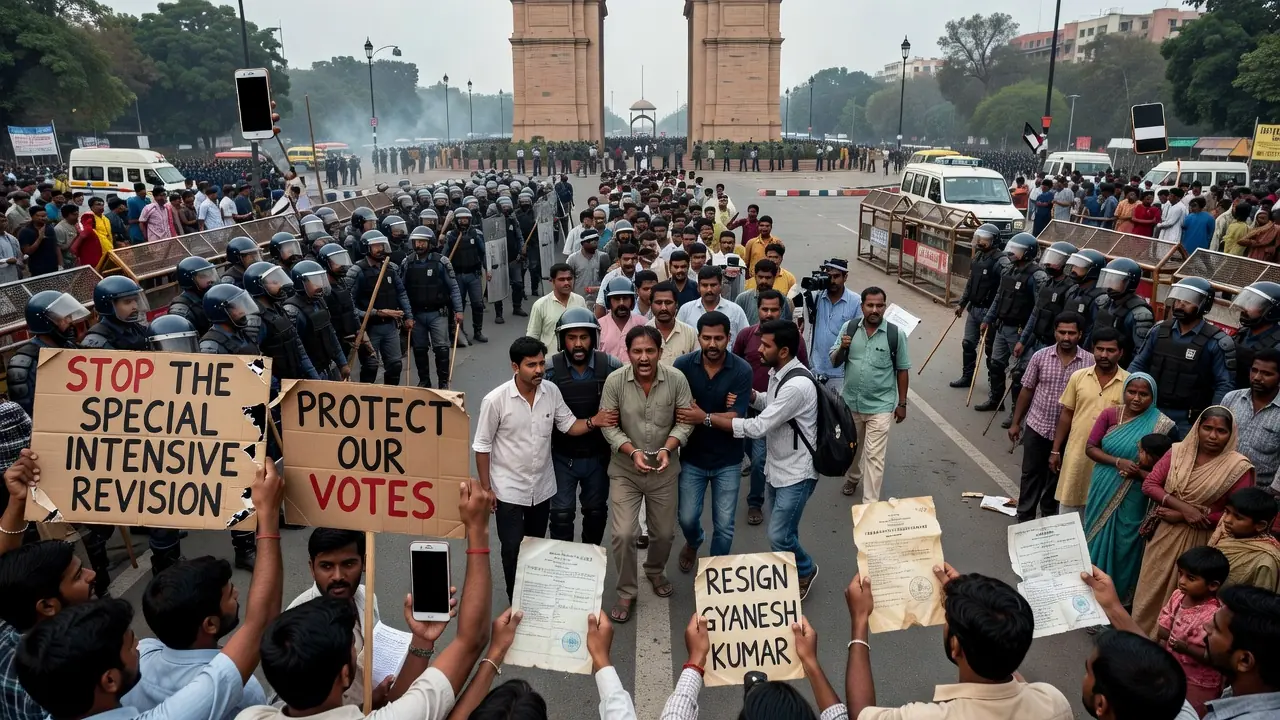
Delhi police detained the founder of the Cockroach Janta Party, Abhijeet Dipke, along with hundreds of other demonstrators, to prevent a planned rally demanding the resignation of India's chief election commissioner, Gyanesh Kumar. The operation involved a sweeping security lockdown across parts of the capital, with security forces deployed in large numbers and travel and telecommunications links suspended. The target of the protest was the Special Intensive Revision, a nationwide exercise reshaping who remains eligible to vote in the world's largest democracy.
Why the voter list revision is contentious
The Special Intensive Revision, launched in June last year, shifts the burden of proof onto existing voters rather than election authorities. Citizens must produce decades-old documentation - birth records, land papers, education certificates - to stay on the rolls. For India's vast population, many of whom are migrants, poor, or lack formal paperwork, this threshold is not a technicality. A single spelling discrepancy in an old document can trigger removal from the list. Because welfare entitlements in India are frequently linked to voter registration, losing that status can mean losing access to state support as well as the ballot.
More than 130 million people have reportedly been struck from the electoral rolls under this exercise. Opposition parties argue the pattern of deletions has disproportionately affected Muslim voters in states such as West Bengal, Bihar, Delhi, and Assam - communities seen as less likely to support the governing Bharatiya Janata Party. The opposition has taken the matter to the Supreme Court and is calling for Kumar's resignation, citing a lack of transparency in how the revision was designed and executed.
A credibility problem for the Election Commission
SY Quraishi, who led India's election commission between 2010 and 2012, has described the institution's current standing as badly diminished, saying public faith in the process has been shaken. That erosion of trust matters beyond this single dispute: election commissions function as neutral arbiters only when their procedures are seen as consistent and verifiable. When a voter-roll methodology is contested by courts, opposition parties, and former officials simultaneously, the institution's authority weakens regardless of the outcome.
Detentions, press access, and the right to protest
Amnesty International India has condemned the scale of the detentions, saying reports point to more than 5,000 people held, including opposition figures, student leaders, journalists, and lawyers. The organisation has called for the unconditional release of those detained solely for peaceful assembly and for restrictions on protest to be lifted. The Committee to Protect Journalists has separately raised concerns about reporters being detained, having movement restricted, and equipment confiscated while covering the unrest, calling on police to allow press access without interference.
The government has rejected these characterisations. A BJP spokesman dismissed the demonstrators as "anarchic elements" and said the protests do not reflect the country's broader mood. Political analysts, however, note the timing is notable: the movement has already forced one ministerial resignation this year and arrives as the governing party faces broader political pressure.
A movement with a short but assertive history
- The Cockroach Janta Party formed in May as a satirical response to a remark by India's Chief Justice comparing unemployed youth and activists to "cockroaches."
- In June and July, protests over exam system failures led to the resignation of Education Minister Dharmendra Pradhan after sustained demonstrations and talks with federal ministers.
- In October, the group launched "Protest 2.0," shifting its demand to the resignation of the chief election commissioner over the voter list revision.
- Demonstrations spread to Bengaluru and Mumbai, with other groups, including the All India Students' Association, joining the campaign in Delhi.
Whether this second campaign achieves the same result as the first remains uncertain. What is clear is that a dispute ostensibly about electoral administration has become a wider test of how Indian authorities respond to organised dissent, and how much scrutiny the mechanics of voter verification can withstand before public confidence is further strained.