
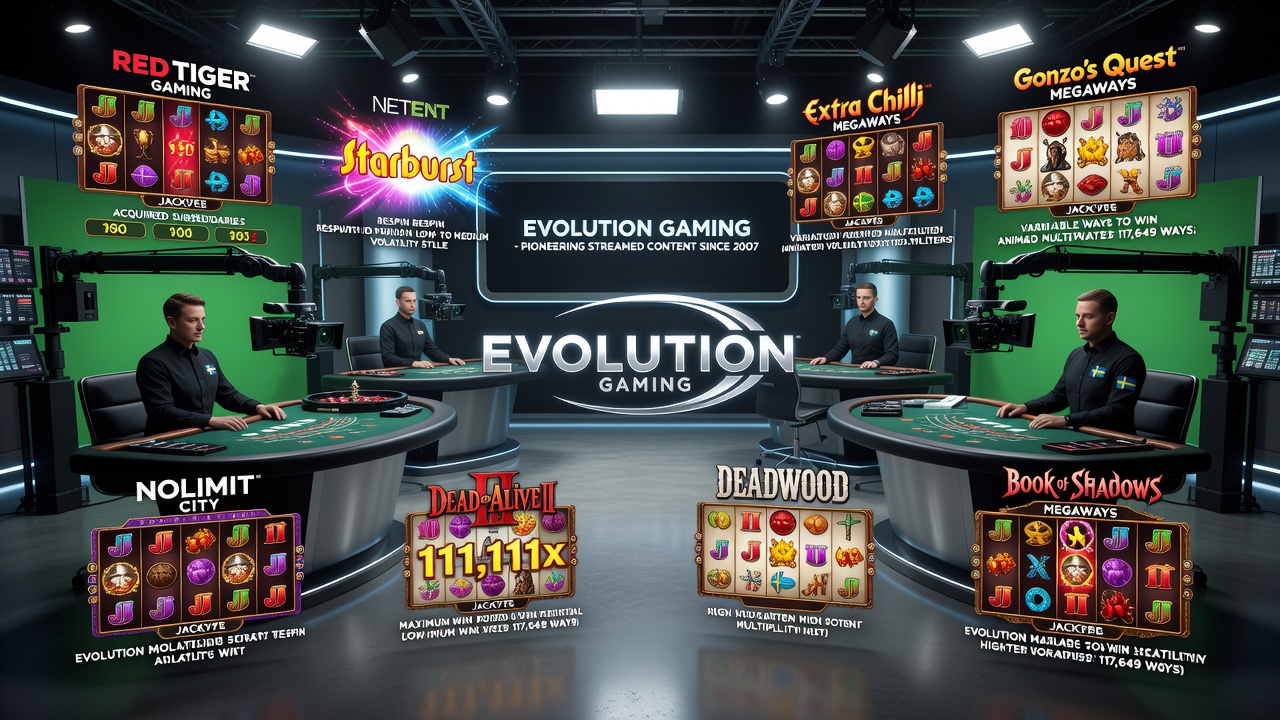
Evolution Gaming has quietly become one of the most influential names in online casino content without most players ever noticing the shift. Best known for live dealer tables streamed from studio floors, the Swedish company has spent the past several years buying up slot developers and reshaping what a "live casino supplier" actually means. The result is a business that now sits behind a large share of the games UK players encounter, often without realizing several brands trace back to the same corporate owner.
From Live Dealer Pioneer to Multi-Brand Supplier
Founded in Sweden in 2006, Evolution built its reputation on live blackjack and roulette, introducing streamed dealer games in 2007 at a time when most online casino content was purely computer generated. By 2010, the company had secured business-to-business licences with the UK Gambling Commission and Malta Gaming Authority, giving it the regulatory footing to supply operators across Europe's most scrutinized markets. That licensing groundwork mattered: B2B suppliers to UKGC-licensed operators are subject to their own compliance expectations, even though they don't hold consumer-facing licences themselves.
The company's expansion into slots came later and through acquisition rather than in-house development. Red Tiger joined in 2019, NetEnt followed in 2020, Big Time Gaming arrived in 2021, and Nolimit City became part of the group in 2022. Each deal brought an established game catalogue and a distinct studio identity, rather than folding everything into a single generic brand.
Why Consolidation Matters for Players and Regulators
This pattern of consolidation is not unique to Evolution; it mirrors a broader trend in iGaming where a handful of large suppliers now provide content to a disproportionate number of operators. For players, that concentration can mean less genuine variety than it appears, since games branded differently may share underlying mechanics, RTP philosophies, or even back-end infrastructure. For regulators, it raises questions about market concentration and the practical difficulty of overseeing supply chains where one company's technology underpins dozens of ostensibly competing casino sites.
It also changes how responsibility is distributed. Operators remain the licensed entity directly accountable to players, but suppliers increasingly build responsible gambling features - session reminders, reality checks, self-exclusion hooks - directly into game and platform architecture. When a handful of studios supply most of the market, the design choices made at that level carry outsized influence over player experience across many brands simultaneously.
What the Games Actually Offer
Evolution's subsidiary slots vary considerably in volatility and mechanics, which matters more to outcomes than branding does. NetEnt's Starburst remains a low-to-medium volatility title built around expanding wilds and respins, while Dead or Alive II carries much higher volatility and a steep 111,111x theoretical maximum win - figures that describe mathematical possibility, not likely outcomes for any individual session. Megaways-style titles like Gonzo's Quest Megaways and Big Time Gaming's Extra Chilli Megaways introduce variable ways-to-win on each spin, a mechanic now licensed and replicated across the industry.
- RTP figures (typically 96%-97% across these titles) represent long-run theoretical averages, not short-term guarantees.
- High volatility games like Deadwood and Book of Shadows can produce long losing stretches between larger wins.
- Bonus buy features, now common across Nolimit City and Big Time Gaming titles, let players pay directly for bonus rounds - a mechanic some regulators have scrutinized for accelerating losses.
The Bigger Picture
Evolution's trajectory reflects where the supply side of online gambling is heading: fewer, larger technology groups controlling more of what players actually see, regardless of which casino brand sits on the homepage. That scale brings production quality and game variety, but it also means scrutiny of a single supplier's practices - on game design, marketing support, or responsible gambling tooling - has consequences that ripple across dozens of operators at once. Understanding who actually built the game behind the interface is becoming as relevant to informed play as understanding the odds themselves.