
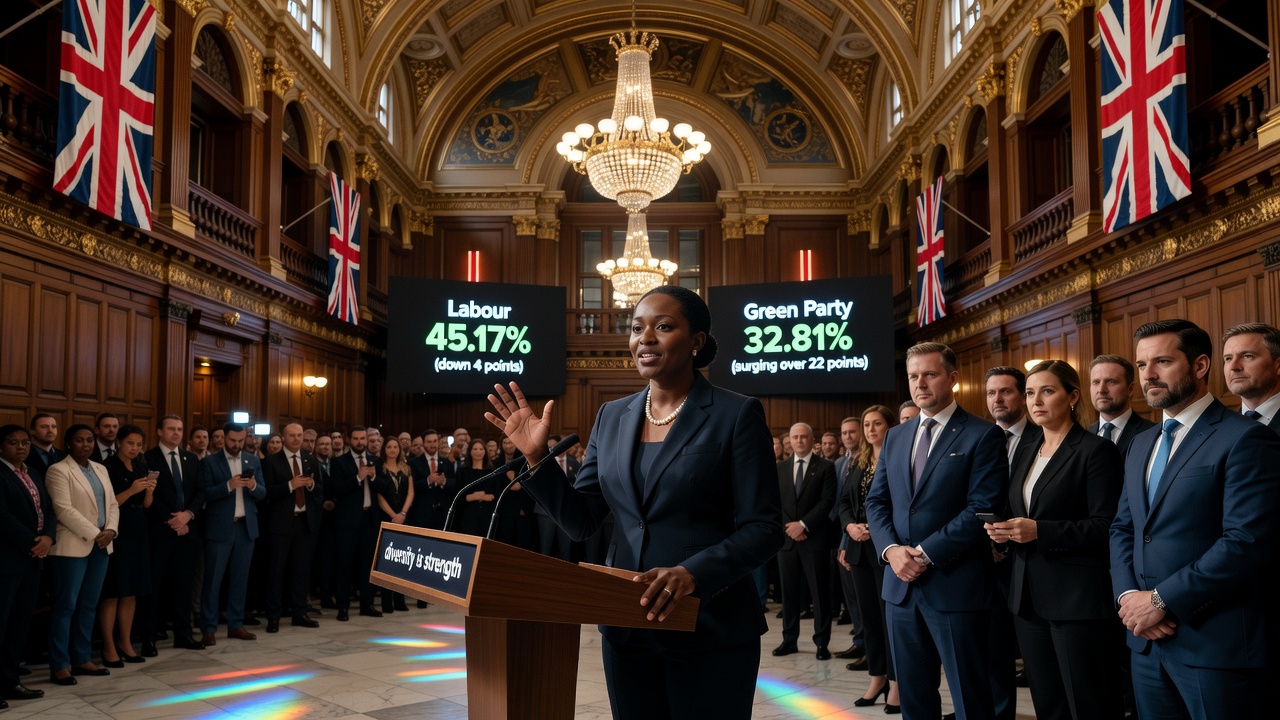
Labour's Sagal Abdi-Wali has won the Holborn and St Pancras by-election, succeeding former prime minister Sir Keir Starmer as the constituency's MP. But the headline figure to come out of the count is not the winning margin - it is the scale of the swing towards the Green Party, whose leader Zack Polanski pushed Labour's majority down sharply and finished more than 20 points up on the party's previous result.
A contest that reshaped the local political map
Abdi-Wali took 45.17% of the vote, a fall of nearly four points compared with the seat's last contest, while Polanski's Greens jumped to 32.81%, a swing of over 22 percentage points. That left the gap between first and second place at under 13 points, a remarkably tight margin for a seat Labour has held through multiple parliaments. The Conservatives, Reform UK and the Liberal Democrats all saw their vote shares fall, suggesting the contest increasingly became a straight fight between Labour and the Greens rather than a traditional multi-party split.
By-elections triggered by a prime minister's resignation carry symbolic weight beyond the immediate result. They act as an early test of public sentiment toward the governing party at a moment of transition, and the scale of the Green advance here will be read by both parties as a signal rather than an anomaly confined to one constituency.
Campaign conduct under scrutiny
The contest was marked by controversy over comments from Reform UK's Zia Yusuf, who questioned Abdi-Wali's candidacy by referencing her birth in Somalia. The remarks were widely condemned, including by business secretary Jonathan Reynolds, and became a recurring theme in Abdi-Wali's own public remarks after her win. She framed her victory explicitly around inclusion, telling supporters that "diversity is strength" and that the result represented winning "by bringing people together" rather than through division.
Abdi-Wali's personal story - arriving in the UK as a child refugee from Somalia's civil war, later leading Camden Council's housing team and becoming the borough's first black female council leader - featured heavily in her campaign narrative and in her victory speech, where she described the win as "deeply personal."
Policy priorities and party fallout
Abdi-Wali has signalled two early priorities: tackling homelessness and rough sleeping, and bringing Thames Water into public ownership, both issues she says dominated doorstep conversations in the constituency. Her focus on housing and utilities reflects wider pressures facing urban Labour MPs, where cost-of-living concerns and infrastructure failures remain politically potent.
For the Greens, the result raises questions rather than settling them. Polanski has confirmed he will remain party leader despite falling short, arguing the campaign served as a platform for Green positions on rent controls, climate policy and water nationalisation. He also used the post-election period to address the party's recent "Zionism is racism" conference motion, distancing criticism of Israeli state policy from antisemitism while facing continued scrutiny over the wording and its reception among Jewish communities.
What the numbers suggest for both parties
- Labour retained the seat but with a reduced majority, pointing to softening support even in a traditionally safe constituency.
- The Green Party's vote share more than doubled on its prior performance, its strongest indicator yet of growing appeal in urban, left-leaning seats.
- Smaller parties, including Reform UK, the Conservatives and the Liberal Democrats, all lost ground, reinforcing a narrower two-party dynamic in this contest.
- Minor and fringe candidates, from Rejoin EU to the Monster Raving Loony Party, collectively drew a small fraction of the vote, consistent with typical by-election patterns.
The result will be parsed closely by both main parties as they assess whether Holborn and St Pancras reflects a localised shift or the early signs of a broader electoral realignment ahead of future contests.