
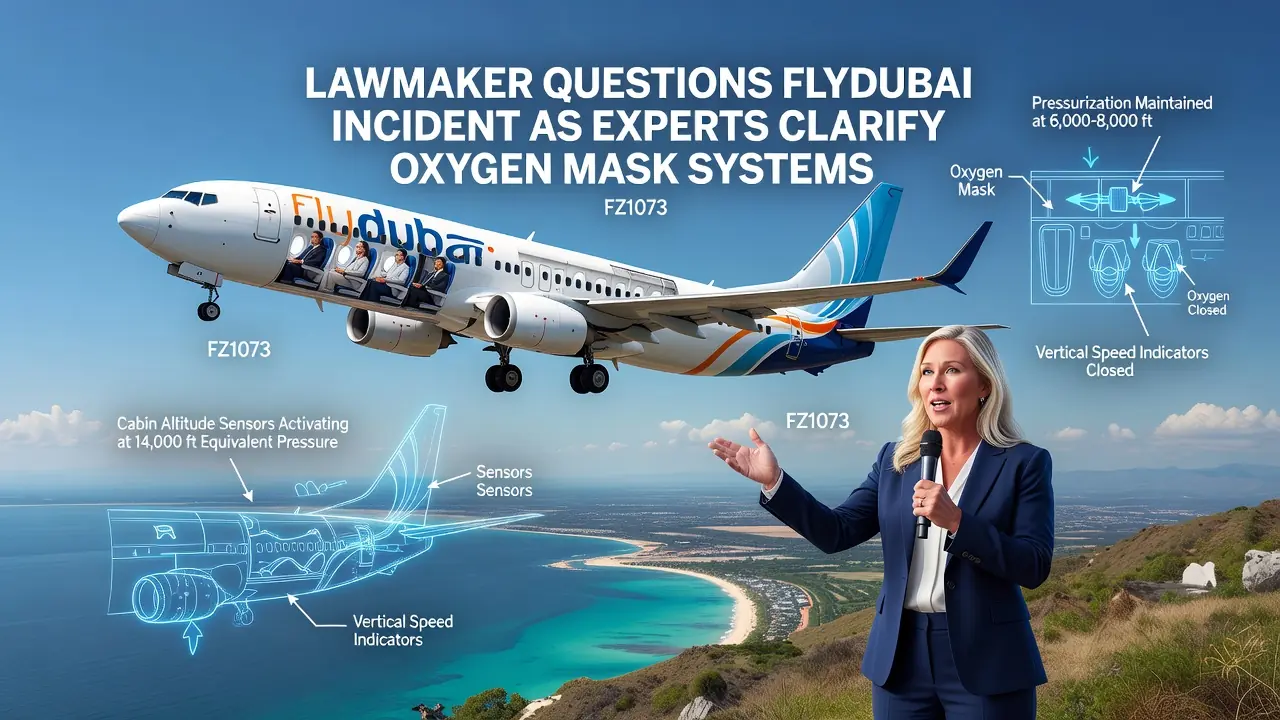
A sudden and severe loss of altitude aboard Flydubai flight FZ1073 has drawn public scrutiny after US Representative Marjorie Taylor Greene questioned why oxygen masks did not appear to deploy during the aircraft's descent of more than 14,000 feet. Her comments, shared widely online, have reignited debate about how much the public actually understands regarding commercial aviation safety systems. The underlying cause of the descent remains under formal investigation.
What Actually Triggers an Oxygen Mask Drop
Commercial aircraft are engineered so that passenger oxygen masks deploy automatically when cabin altitude, not the rate of descent, crosses a specific threshold. Cabin altitude refers to the simulated pressure environment inside the fuselage, which is normally maintained at a level equivalent to roughly 6,000 to 8,000 feet regardless of how high the plane is actually flying. If that cabin pressure rises to a dangerous level, typically corresponding to an altitude around 14,000 feet of cabin pressurization, sensors trigger the mask system automatically. A rapid descent alone, even one exceeding 14,000 feet, does not necessarily indicate a loss of cabin pressure. Pilots can and do perform fast, controlled descents for a range of operational reasons without any pressurization emergency occurring at all.
This distinction matters because public commentary often conflates altitude change with cabin safety events. Aviation professionals have pushed back on the assumption that a steep descent should automatically correspond with visible oxygen mask deployment, noting that the two systems operate independently of one another.
Why Public Figures Weighing In Changes the Conversation
When a sitting member of Congress raises questions about an aviation incident, the moment shifts from a technical aviation story into a broader public communication issue. Social media amplifies such statements quickly, often stripping away the nuance that aviation investigators rely on. Flight data recorders, cockpit voice recorders, and maintenance logs take time to analyze, and credible conclusions typically arrive weeks or months after an event, not within hours of a viral post.
This pattern is not unique to aviation. Across regulated industries, from gaming platforms to financial services, incidents involving public safety or consumer protection often generate speculation before verified facts are available. The gap between public reaction and investigative timelines is where misinformation tends to take hold.
The Role of Formal Investigations
Aviation incidents involving unusual descents are reviewed through established international protocols, generally led by the civil aviation authority of the country where the airline is registered, often working alongside manufacturers and international aviation bodies. These investigations examine altitude data, pressurization readings, crew communications, and mechanical performance before any determination is made public.
- Cabin pressurization systems are distinct from descent-rate controls
- Oxygen masks respond to cabin altitude thresholds, not vertical speed
- Investigations rely on recorded flight data rather than public observation
- Premature conclusions drawn from social media can outpace verified findings
Until Flydubai and relevant aviation authorities release findings, the specific cause of the descent on FZ1073 remains unconfirmed. What is clear is that the absence of visible oxygen masks, on its own, does not indicate that safety systems failed or that the aircraft experienced a pressurization emergency.